Identify the Species
Honey bees, bumblebees and solitary bees behave differently and may need different advice.
Guardian provides professional bee and wasp nest removal in Warrington for homes, businesses and managed properties. We identify the species first, assess the nest location and surrounding risks, then recommend the most appropriate treatment or referral for the situation.
Prompt local attendance for wasp nests, with same-day visits where routing permits.
Nests are treated by trained technicians wearing full protective suits.
We look to relocate bees rather than destroy the colony, often with local beekeepers.
Our bee & wasp nest removal in Warrington starts with accurate identification. Wasps, honey bees, bumblebees and solitary bees can behave very differently, even when they appear to be using the same part of a property. Identifying the species first helps determine whether treatment, monitoring or beekeeper referral is the most appropriate next step.
Wasps are often more active around buildings later in the summer and may establish nests in roof spaces, wall cavities, sheds, trees or the ground.
Honey bees are generally more rounded and hairy than wasps and may sometimes be seen gathering in large numbers or using a cavity within a building.
Bumblebees are large, visibly furry bees that commonly use sheltered spaces such as sheds, roof areas, compost areas or old animal holes.
Unlike honey bees and bumblebees, solitary bees do not usually live in large colonies. Individual bees may use small holes in soil, masonry or timber.

A clear photograph of the insect and the point where it is entering can often help us distinguish between wasps and different types of bees before a visit. Take photographs only from a safe distance.

Avoid sealing an active hole, vent or roof gap before the species has been identified. Trapping insects inside can force them to search for another route, potentially bringing them further into the building.
A steady stream of insects entering and leaving one point often indicates a nest nearby. Keep children, pets and customers away from the area and avoid striking, spraying or sealing the entrance.

Activity around tiles, fascia, soffits and loft openings can indicate a hidden nest.

Wasps may use vents, air bricks, gaps around pipes or damaged pointing.

Quiet roof spaces, stored materials and wall voids can provide shelter.

Nests may be concealed in branches, hollows or dense vegetation.

Some species use holes in lawns, borders or old burrows.

Repeated flight paths near doors, paths or play areas can increase sting risk.
Photographs can help identify the insect, entrance point and access equipment likely to be needed. Take images only from a safe position and never approach a nest to improve the photograph.
Use a zoomed image from a safe distance if possible.
Include the wall, roof, tree or ground area around the activity.
Tell us the floor level, height and whether ladders or restricted access may be involved.
Tell us about allergies, children, care settings or busy public routes.
Do not disturb the nest or stand directly in the flight path.
The treatment method depends on whether the nest is visible, concealed in a cavity or reached through an established entrance. The technician will explain the plan, exclusion area and what activity to expect afterwards.

A visible nest can be assessed directly and treated using a suitable method.

Treatment may be directed through the active entrance without opening the whole structure.

Access height, roof condition and safe working position are considered before treatment.

The entrance and surrounding route are controlled to reduce disturbance.

Timing and exclusion are planned around customers, staff and vulnerable users.
Our wasp nest removal in Warrington is carried out by technicians in full protective equipment. Unlike bees, wasps can sting repeatedly, so please do not try to remove or disturb a nest yourself.
Wasp or bee?
Wasps and bees need different approaches, so we always confirm which you have before anything is treated.
Working at height
Nests in eaves, soffits and roof spaces are reached safely using the right access equipment.

Full protection
Wearing full protective equipment, we treat the nest directly or at its entrance, inside or outside the property.

Protecting pollinators
In all but the most inaccessible places, we look to relocate bees rather than destroy the colony, often with local beekeepers.

Upload a photo with your enquiry, and we will help identify it before we visit.
Guardian does not treat bees as wasps by default. We first identify the likely species and location, then advise whether the insects can be left safely or referred to a beekeeper for possible relocation.
Honey bees, bumblebees and solitary bees behave differently and may need different advice.
A colony in a remote area may not require intervention, while activity inside a building needs closer assessment.
Do not spray or seal bees into a cavity before advice is obtained.
Where appropriate, Guardian can direct the enquiry towards a beekeeper who may be able to help.
Bees inside a structure may require a coordinated approach depending on location and access.
Bees and wasps can look similar from a distance but may need very different responses. Send us a clear photograph from a safe position, and we can help identify what you are dealing with before treatment or referral is considered.
Have questions about our wasp nest removal in Warrington? Here are answers to the things customers ask most, from bees to what happens after treatment.
Bees are valuable pollinators, so we do not treat them as pests where it can be avoided. In all but the most inaccessible places, we look to relocate them, often by contacting local beekeepers. If you have a honey bee swarm, the British Beekeepers Association can also help.
We strongly recommend that you do not. Wasps defend their nest aggressively and, unlike bees, can sting many times. Stings are painful and can cause serious allergic reactions in some people. The NHS advice on insect bites and stings explains when to seek medical help.
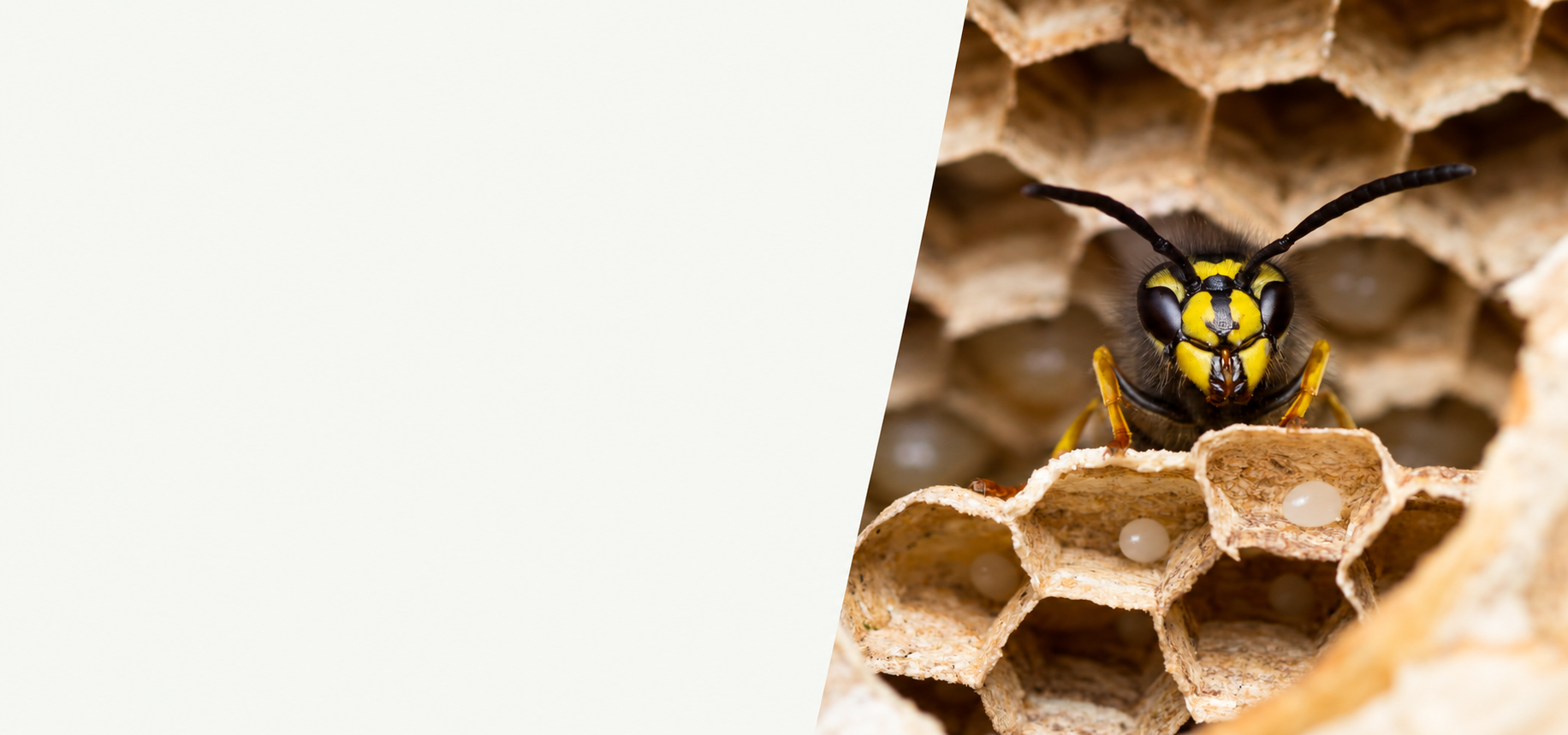
Wasp nests are usually grey and papery, and wasps are smooth with bright yellow and black stripes. Bees are hairier, and honey bees build wax comb. If you are not sure, upload a photo with your enquiry, and we will help identify it.
Guardian usually aims to attend within 24 hours, subject to technician availability and location. Same-day visits may be possible where routing permits. Late summer is our busiest time, so it is worth calling as soon as you notice a nest.
Not always. Wasps returning to the nest may stay active around the entrance for a short time after treatment. We will explain how long to keep people and pets clear and what to expect.
Wasps do not reuse old nests, but a new queen may build in a similar sheltered spot. Checking lofts, eaves and outbuildings in spring, and sealing suitable gaps, can help reduce the risk.
Yes. We treat wasp nests at commercial premises as well as homes, including schools, offices, warehouses and food businesses, and can work around your opening hours.
Call us or send a message using the form below, and we’ll get back to you as soon as possible.